

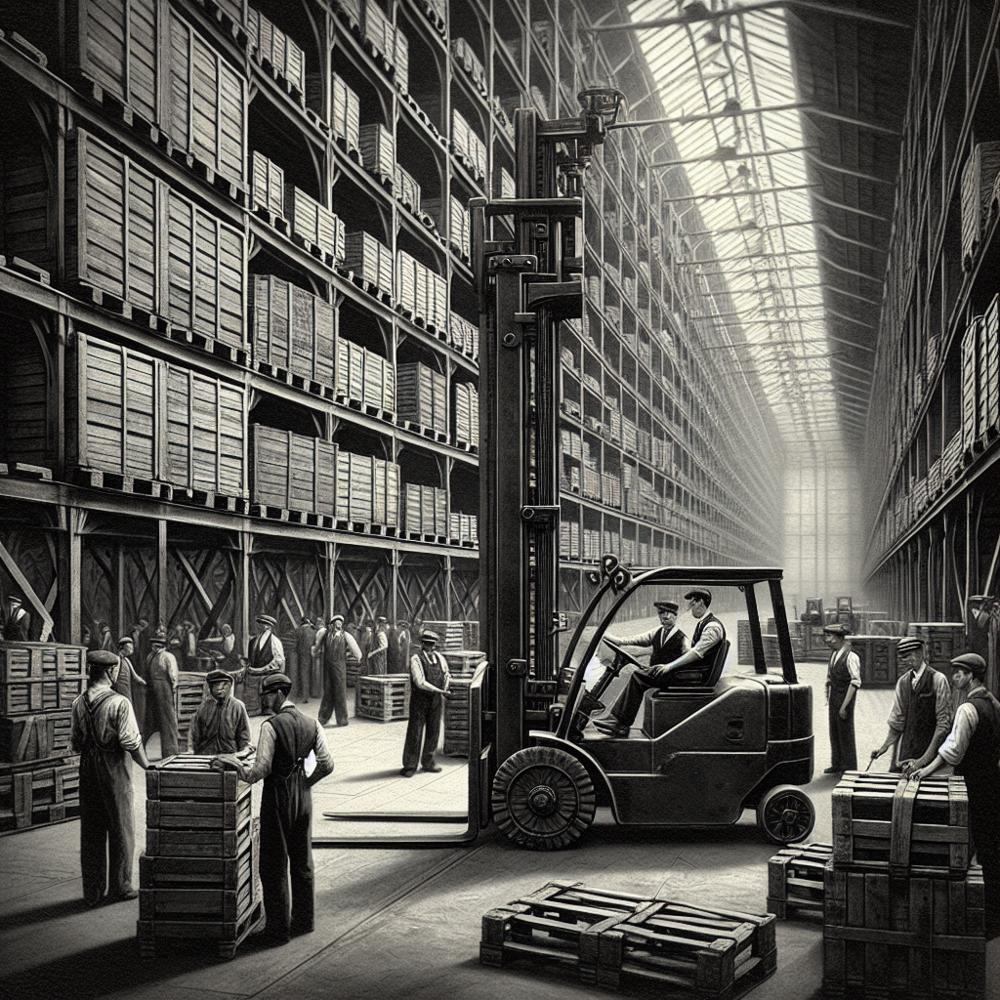
Forklifts are an integral part of modern industry and logistics, contributing to significant improvements in goods transportation. What a fascinating and innovative evolution this technology has undergone from its humble beginnings! In today’s article, we will look at the history of forklifts and the breakthrough moments that resulted in the creation of equipment essential for ensuring efficiency and effectiveness in warehouses and stores worldwide. We invite you to discover this fascinating history!
First Forklift Designs and Their Simple Applications
Forklift history dates back to the first attempts to use levers for moving loads. Already in ancient Egypt, quite primitive constructions were used to place large stone blocks in their places on pyramids. However, the real revolution in goods transportation came only at the beginning of the 20th century, when American engineers began introducing typically logistical solutions based precisely on the forklift.
Major Breakthrough: Electric-Powered Forklift
The initial development of the forklift was quite limited – mainly due to the lack of appropriate technologies that would allow for their mass application. It was then that unknowingly a company conducting research on the use of electricity in industry developed the first electric-powered forklift. This proved to be a breakthrough moment in forklift history, opening doors to many applications and improvements.
Further Evolution: Use During World War II
The technological advancement of the early 20th century also translated into increasingly greater forklift efficiency. During World War II, growing needs in goods transportation made forklifts become an integral part of military logistics. Forklift improvements introduced during this conflict served as inspiration for subsequent changes in their construction and functions.
Post-War Economic Boom and Later Changes
After the end of World War II, an economic boom occurred, which additionally contributed to increased demand for equipment facilitating goods transportation. Along with the increase in forklift orders, their designs were further improved. Models with combustion engines, greater efficiency, and environmentally friendly features appeared. Supply in the market and the offer of various forklifts increased significantly, we can say that forklift history became richer by another chapter.
Current Exciting Trends in the Forklift Industry
Currently, the forklift market is a wide range of devices with different parameters and functions. Over the years, changes have also occurred in the materials from which they are made, now mainly lightweight and durable constructions. What comes to mind is the mass application of technology related to the use of lithium-ion batteries and GPS networks, which allow for more efficient work process management.
Future of Forklifts: Automation and Ecology
Certainly, the development of new technologies determines the most interesting directions of forklift evolution. This includes both increasing care for air quality and vibration reduction, as well as increasing automation of their operation. There are visible tendencies to create unmanned forklifts that will be able to move independently through warehouses and stores, based on counters and GPS tracking systems. This is another breakthrough moment in forklift history, which perhaps will soon influence our daily lives.
Contemporary Phenomena and Longevity of Forklifts
The history of forklifts is extremely fascinating and shows their evolution from the most basic constructions used in ancient Egypt to highly technically advanced solutions used today. The breakthrough came with the invention of electric drive, and the needs of World War II and the post-war economic boom additionally contributed to the development of the forklift sector. An interesting fact is the mass application of lithium-ion battery and GPS technology, which allowed for more efficient work management.
In the future, we can expect increasing automation of forklifts that will be able to function unmanned, as well as increasing care for ecology. In the perspective of the coming years, the forklift sector will continue its remarkable evolution, perhaps changing our daily lives and the way the economy functions.


