

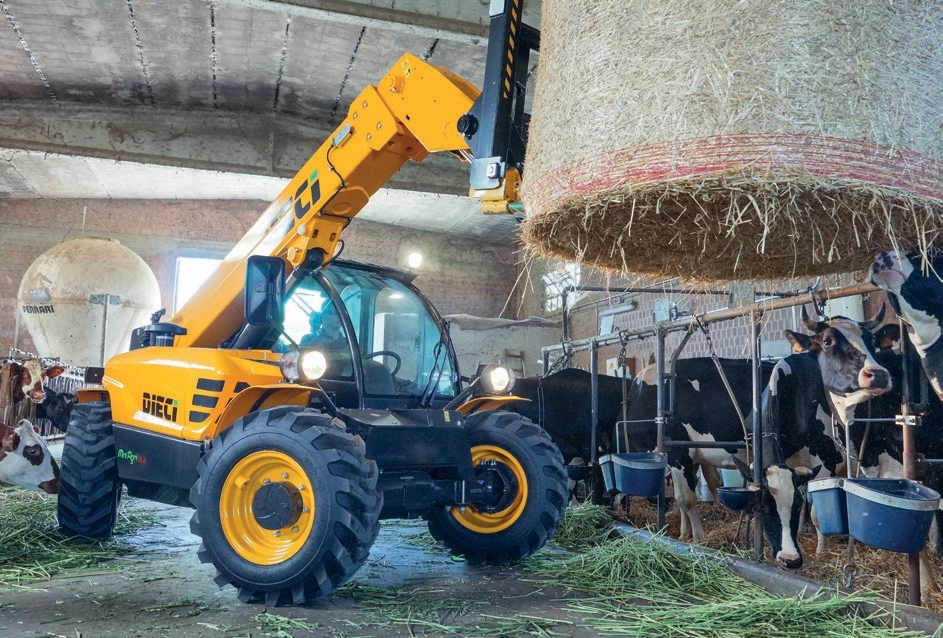
Introduction to Low Telescopic Loaders
In the dynamically developing world of construction and agricultural machinery, low telescopic loaders stand out as an indispensable tool that not only facilitates but revolutionizes the way precise operations are carried out on construction sites and in agricultural farms. These extremely versatile machines harmoniously combine the functions of lifting, transport, and precise positioning of loads, while offering an intelligent design that enables efficient operation in compact spaces and on various surfaces, significantly increasing their usefulness and reducing working time. Learn more about low telescopic loaders, their models, applications and benefits.
We present below the key features that distinguish low telescopic loaders from other equipment available on the market:
- Operational versatility: ability to perform various tasks thanks to interchangeable attachments.
- Ability to work in hard-to-reach places: capability to operate in tight or complicated spaces.
- Various accessories increasing functionality: wide selection of additional tools adapting the machine to specific needs.
- Small size, ideal for maneuvering: compact construction enabling easy movement and precise operation in limited spaces.
In the construction and agricultural sectors, low telescopic loaders find wide application in tasks such as:
- Lifting heavy construction materials: efficient lifting and placing of heavy blocks, concrete beams or other structural materials.
- Transporting materials within the construction site: effective movement of construction materials on the construction site area.
- Positioning loads in hard-to-reach locations: precise placement of loads in places that are difficult to reach with other machines.
Definition and Functionality of Low Telescopic Loaders
Low telescopic loaders are advanced work vehicles, precisely designed for tasks related to lifting and transporting various loads. Key functions of these machines play a fundamental role in their efficiency:
- Lifting: they enable efficient and effective lifting of heavy loads to significant heights, which is invaluable on construction sites despite complicated spatial layouts.
- Transport: they perform excellently in dynamic working conditions, enabling quick and trouble-free movement of goods between different operational areas.
- Load positioning: they allow for precise placement of loads in exactly designated places, which increases the accuracy and efficiency of performed tasks.
It is particularly worth noting that unique features, such as modular construction enabling easy attachment exchange, significantly enhance the functionality of low telescopic loaders, making them an indispensable tool in various industrial applications.
Differences Between Low Telescopic Loaders and Traditional Construction Machines
Low telescopic loaders offer significant efficiency and versatility that distinguish them from traditional construction machines. The following table illustrates key differences that make low telescopic loaders a more beneficial choice in many applications:
| Feature | Low Telescopic Loaders | Traditional Construction Machines |
|---|---|---|
| Versatility | High – ability to perform various tasks thanks to interchangeable accessories. | Low – limited functionality to specific tasks. |
| Ability to work in tight spaces | Excellent – compact construction enabling operation in hard-to-reach places. | Limited – larger sizes make work in narrow areas difficult. |
| Final price | Varied – wide selection of models adapted to different budgets. | Stable – less price diversity, which may limit choice. |
These comparisons clearly show how beneficial the use of low telescopic loaders can be in daily work, offering greater flexibility and economic efficiency of operations compared to traditional construction machines.
Advantages of Low Telescopic Loaders
Low telescopic loaders are devices that not only attract the attention of professionals from the construction and agricultural industries, but also gain recognition thanks to their numerous advantages that significantly facilitate the performance of daily duties. Here are some of their main assets:
- Versatility: Excellent for various tasks, including lifting, transport and precise positioning of loads.
- Efficiency: They enable quick and precise operations, which translates into increased productivity and time savings.
- Maneuverability: Compact sizes facilitate work in tight and limited spaces, minimizing the need to move the entire machine.
Versatility of Applications in Construction and Agriculture
Low telescopic loaders are characterized by a wide range of applications in both the construction and agricultural industries, making them extremely valuable in various operational contexts. Examples of their applications include:
- Construction: Efficient lifting and placement of structural materials such as bricks, concrete blocks or prefabricated elements, enabling smooth implementation of construction projects. More information about applications of low telescopic loaders.
- Agriculture: Transporting grain, hay and other agricultural products, as well as carrying out precise operations related to cultivation and harvesting, which increases work efficiency on the farm.
Thanks to such applications, low telescopic loaders become an essential tool in both fields, offering unparalleled flexibility and the ability to adapt to specific operational needs.
Efficiency of Lifting and Transporting Heavy Loads
The performance of low telescopic loaders in lifting and transporting heavy loads is truly impressive, making them ideal helpers on any construction site or farm. Some models offer lifting capacity up to 3 tons and reach exceeding 7 meters, enabling the completion of even the most demanding tasks. Key parameters include:
- Lifting capacity: Models can offer lifting capacity from 1 to 3 tons, allowing flexible adaptation to different transport needs.
- Lifting height: Range from 5 to 10 meters, depending on the model, enabling work on large structures or storage of materials at heights.
- Type of attachment: Possibility of mounting various accessories such as forks, grabs or buckets, which increases the versatility and adaptability of the machine to specific tasks.
Small Size and Ease of Maneuvering in Tight Spaces
Despite their small size, low telescopic loaders surprise with their ability to move in tight spaces, which is crucial in situations where precision and speed of operations are essential. Their key advantages include:
- Easy access to hard-to-reach places where larger machines cannot operate.
- Performing precise maneuvers without the need to move the entire machine, which saves time and increases work efficiency.
- Ability to work in limited spaces on construction sites, warehouses or agricultural areas, allowing optimization of operational processes.
User Opinions and Performance Tests
User opinions about low telescopic loaders are predominantly positive, confirming their reliability and functionality in practical applications. Here are a few key quotes from people who use them:
“Thanks to the low telescopic loader, I gained extraordinary versatility in work, which significantly accelerated project implementation.”
“It’s an ideal solution for construction, easy to maneuver in tight spaces without compromising performance.”
Performance test results confirm excellent achievements of models, with key results emphasizing their versatility and operational efficiency, which further strengthens their position as leaders in the construction and agricultural machinery market.
News and Trends in Low Telescopic Loader Technologies
The construction and agricultural machinery industry is constantly developing, and low telescopic loaders are gaining increasing importance thanks to the introduction of innovative technologies that enhance their functionality and efficiency. Here are some of the latest trends and technological innovations:
- Modern control system: Advanced technologies enabling precise management of machine functions, increasing operation accuracy and operator comfort.
- Ecological solutions: Machine development based on reducing fuel consumption and exhaust emissions, which aligns with global environmental protection efforts.
- New accessories: Innovative additional tools allowing expansion of machine functions, increasing its versatility and adaptability to different tasks.
Innovations in Telescopic Boom Design
Designers of low telescopic loaders constantly seek new solutions aimed at increasing performance and work safety. Innovations in telescopic boom construction include:
- Better stability when lifting heavy loads, minimizing the risk of machine tipping and increasing operation safety.
- Improved hook and lock mechanisms that provide greater load security and facilitate their quick and safe lifting.
- Automatic leveling systems that enable even better operation precision, eliminating errors resulting from terrain unevenness.
New Accessories and Equipment Increasing Functionality
The contemporary increase in functionality of low telescopic loaders is supported by a wide range of modern accessories that enable even greater adaptation of machines to specific user needs. Among the most important accessories are:
- Pallet forks: Enabling stable transport of palletized materials, invaluable in warehouses and construction sites.
- Grabs: Facilitating lifting of unusual objects such as barrels, containers or steel structures, increasing machine versatility.
- Buckets: Excellent for earthworks such as digging, soil loading or transferring bulk materials, expanding the range of telescopic loader applications.
Ecological Approach to Equipment Production and Use
In response to growing global environmental protection requirements, the construction and agricultural machinery industry increasingly focuses on ecological initiatives. Among them are:
- Production of machines from renewable and recycled materials, reducing negative impact on the natural environment.
- Reduction of exhaust emissions through the use of modern, ecological engines, which not only protects the environment but also meets increasingly stringent emission standards.
- Supporting users in efficient machine operation, leading to reduced fuel consumption and increased energy efficiency, contributing to lower operational costs.
Purchasing a Low Telescopic Loader: What’s Worth Knowing?
The decision to purchase a low telescopic loader should be thoughtful and well-planned to ensure optimal investment utilization. Below we present key aspects worth considering before finalizing the purchase:
- Budget: Precise determination of financial resources allocated for purchase, considering not only the price of the device itself, but also operating costs, service and potential accessories.
- Models: Selection of a model adapted to individual operational needs, taking into account parameters such as lifting capacity, telescope reach and attachment availability.
- Manufacturer reputation: Trust in a proven and reputable brand that guarantees quality, reliability and availability of service and spare parts.
Criteria for Selecting the Right Model
When selecting a model of low telescopic loader, it’s worth paying particular attention to several key parameters that determine its efficiency and adaptation to specific operational needs:
- Lifting capacity: Key parameter determining the ability to transport loads, which should be appropriately matched to typical tasks performed by the machine.
- Reach: Important indicator in the context of lifting materials in specific places, enabling work at different heights and in different operational areas.
- Additional functions: Possibility of adding additional functions such as advanced control systems or additional accessories that increase the range of possible operations.
Estimating Operational Needs and Costs
Before purchasing a low telescopic loader, it’s worth accurately estimating operational needs and related costs to ensure optimal machine utilization and expense minimization. Aspects worth considering include:
- Expected frequency of machine use, which will help determine necessary technical parameters and device durability.
- Types of tasks to be performed, allowing selection of appropriate attachments and additional functions.
- Service and spare parts expenses, which are crucial for maintaining machine high performance and extending its lifespan.
Where to Look for the Best Offers and Promotions
The best offers for low telescopic loaders can be successfully found in several key places that guarantee attractive prices and high quality of offered products:
- Reputable construction equipment dealers who offer a wide selection of models and professional advice in choosing the right machine.
- Specialized online services that enable comparison of different models and manufacturers, as well as access to other users’ opinions.
- Industry trade fairs where the latest technological innovations are exhibited, as well as the possibility of direct contact with manufacturers and negotiating favorable purchase conditions.
Summary of Low Telescopic Loader Advantages
Low telescopic loaders are an investment that brings real benefits, both in terms of increased operational efficiency and time and cost savings. Key aspects include:
- Versatility: enables work in various situations and contexts, increasing operational flexibility.
- Efficiency: significantly increases productivity in lifting and transporting loads, translating into faster project implementation.
- Ease of maneuvering: thanks to compact dimensions, the machine is easy to operate in tight spaces, minimizing downtime and increasing productivity.
Why Invest in a Low Telescopic Loader?
Low telescopic loaders are an excellent investment for many reasons that translate into long-term benefits for both construction and agricultural companies. Here are the most important ones:
- Possibility of return on investment through increased operational efficiency, meaning faster project implementation and better resource utilization.
- Ecological approach that brings not only environmental but also financial benefits through reduced fuel consumption and operating costs.
- Versatility that allows the machine to adapt to various tasks, contributing to long-term benefits through increased efficiency and operational flexibility.
Future of Low Telescopic Loaders in Construction and Agricultural Industries
The future of low telescopic loaders looks promising, due to continuous technology development and growing demand for efficient and ecological solutions in construction and agricultural industries. Expected trends include:
- Development of autonomous technologies: introduction of automation of part of work processes, increasing precision and reducing the need for manual machine operation.
- Increased importance of sustainable development: environmentally friendly production and use of renewable materials will become standard, responding to global ecological challenges.
- Innovations in attachment adaptation: greater possibility of adaptation to different tasks thanks to modular construction and wide range of accessories, further increasing machine versatility and functionality.

Most Important Information in the Article:
- Low telescopic loaders are versatile machines used in construction and agricultural industries that combine lifting, transport and precise load positioning functions.
- Operational versatility: Thanks to interchangeable attachments, low telescopic loaders can perform various tasks, increasing their flexibility in different applications.
- Operational efficiency: Modern control systems and intelligent construction enable quick and precise operations, significantly increasing productivity.
- Maneuverability: Compact construction allows operation in tight spaces and hard-to-reach places, which is crucial on construction sites and farms.
- Various applications: In construction they serve to lift heavy materials and transport on construction sites, while in agriculture for transporting grain, hay and precise cultivation operations.
- Technological innovations: Development of ecological engines, automatic control systems and advanced accessories increases functionality and environmental friendliness.
- Differences compared to traditional machines: Low telescopic loaders offer higher versatility, better ability to work in limited spaces and greater price flexibility.
- Selection criteria: When purchasing, consider budget, appropriate model adapted to operational needs and manufacturer reputation guaranteeing quality and reliability.
- Future of machines: Further development of autonomous technologies, increased importance of sustainable development and innovations in attachment adaptation are expected, which will enhance their efficiency and functionality.
- User opinions: Positive reviews confirm the reliability and functionality of low telescopic loaders in practical applications.














