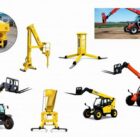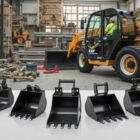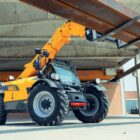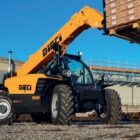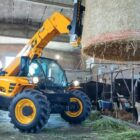


In recent years, through their usefulness, simple operation, and compact size, forklifts have begun to find more and more applications, used by companies and private individuals. In some areas of work, it’s hard to imagine functioning without mechanical assistance, which is most often needed in places such as: sawmills, warehouses, farms, or production halls. In today’s times, work in such places without forklifts could become very difficult, or even impossible. Additionally, by equipping forklifts with appropriate attachments, they can be used for many other tasks such as weighing pallets or snow removal.
Fork Extensions for Forklifts
Fork extensions for forklifts are an inconspicuous but useful gadget. They come in different lengths, but all serve the same purpose. They were created to make it easier for users to unload delivery trucks and similar vehicles. Replacing the forklift forks themselves is not as simple as it might seem and, additionally, it’s best if two people do it. When there’s a sudden need to unload a vehicle and the forks turn out to be too short, a small problem may arise. Extensions were created as a solution for this type of situation – they are much lighter than steel forks, can be carried in the forklift, and their installation takes literally a few minutes – just slide them onto the forks. However, it’s important to remember that extensions are not the most durable, so it’s recommended to use them according to the guideline that the forks should constitute at least 60% of the extension length. What does this mean in practice? Here are a few examples:
- 1m forks – extension maximum 1.67m
- 1.1m forks – extension maximum 1.85m
- 1.2m forks – extension maximum 2m
- 1.4m forks – extension maximum 2.35m
- 1.6m forks – extension maximum 2.67m
When used in a manner inconsistent with recommendations, fork extensions may bend or break.
What Fork Extensions Are Made Of
They are made from the same material as forks, which is steel, but in a slightly different way. Forks are cast entirely from steel, which makes them so heavy and difficult to install, but also makes them much more durable than extensions, which are only relatively thin elements cast from steel, designed to slide onto forks. The durability of extensions from different manufacturers varies, and the quality of extension workmanship is evidenced by elements such as:
- Quality of the raw material from which they were made.
- Quality of workmanship (referring to elements such as weld quality, quality of mounting used for installation on the forklift)
- Possessed durability certificates and testimonials
- Construction (from technical/design perspective)
Fork Extensions for Forklifts – Are They Worth It?
This is an individual matter for everyone, but extensions undoubtedly have a lot to offer. Among other things, savings – purchasing extensions is much more cost-effective than keeping two pairs of forks, one longer and one shorter. They are also easier for one person to handle than forks, if only because of their lower weight. For example, one fork with dimensions 120x50mm and length 2000mm weighs about 120 kg, while an extension extending to the same dimensions weighs only 30 kg. They therefore provide financial and health savings – when installing forks, you need to use a lot of strength and time, especially when doing it alone. The lack of need to struggle and strain will certainly provide beneficial comfort for the user’s joints and bones.
How to Make Fork Extensions?
Making fork extensions is not particularly complicated – any handyman with little experience should be able to handle it. Everyone will need extensions with individual dimensions – remember to properly measure the forks and follow the 60% rule. To make extensions you will need:
- Materials (closed angle iron)
- Welder/MIG welder
- Angle grinder (for cutting metal)
- Grinding disc for the grinder to grind down sharp edges and smooth the weld
- Fork dimensions (buy angle iron slightly larger)
Also remember to make a safety mechanism at the end of the extension so it doesn’t slide off during work – this can be done in many ways, even by tying it with wire.